Cellulose nanofiber
Product Name 02 Fibrimelt
This is a wet-mixed sheet of cellulose and synthetic fibers that combines the texture of paper with the functionality of synthetic fibers.
Various capabilities can be achieved by adjusting the type and blending ratio of the synthetic fibers according to the application.
Product Features
-
Feature01
...Various combinations of cellulofibril breakdown levels and synthetic fibers are possible.
-
Feature02
...The material is highly elastic and can be press-formed by applying heat.
-
Feature03
...It can be used as a material for cellulose and various resin composites (patent pending).
-
Feature04
...The product is available in sheet form and rolled paper form.
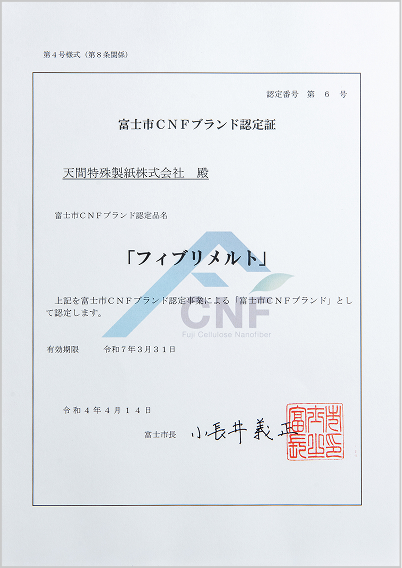
This is a certified Fuji City CNF Brand product.
Fibrimelt is a certified Fuji City CNF Brand product.
Fibrimelt is a CNF paper material developed by our company. It has been recognized as a product that contributes to the revitalization of local industry and the improvement of technological capabilities in Fuji City. And so it has been certified as a Fuji City CNF Brand product.
Fibrimelt is an environmentally friendly, functional material made from cellulose nanofibers applied to paper substrates. It is expected to be used in various fields, such as packaging materials and processed paper.
What is Fuji City CNF Brand Certification?
This is a system under which Fuji City certifies products produced, manufactured, or processed using cellulose nanofiber (CNF), a new plant-derived material, or related technologies, as a brand.
The purpose of this program is to evaluate the quality of products and the technical capabilities of local industries, and to support the establishment of brands and the expansion of sales channels.
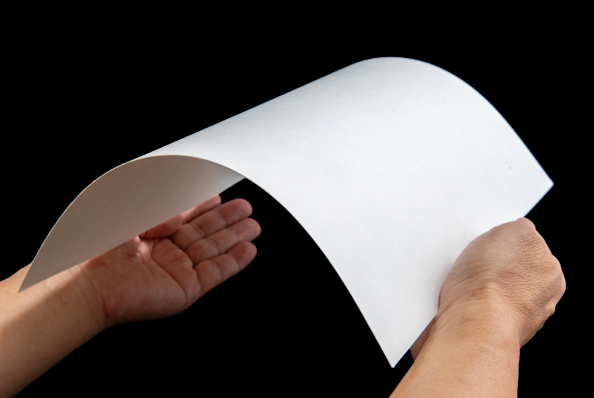
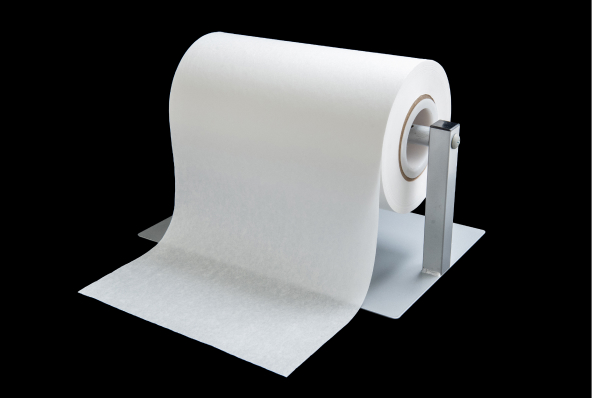
-
Sheet form

-
Rolled paper form
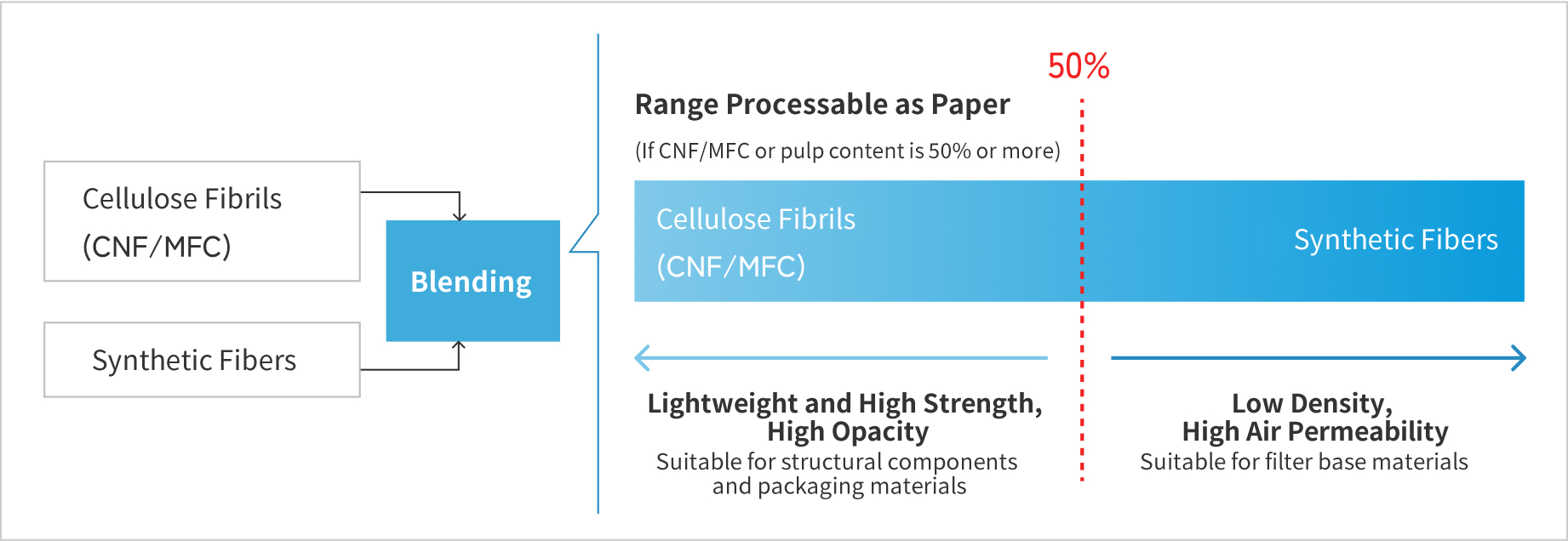
The blending ratio of cellulose and synthetic fibers can be freely adjusted, allowing for unique blending according to the application.
Also, depending on the types of synthetic fibers combined (polypropylene, nylon, polyethylene, etc.), composite materials with different properties can be produced.
In addition, in the production of cellulose and synthetic resin composites, by mixing cellulose and synthetic fibers into sheets,
it is easier to uniformly disperse cellulose in the composite and maintain stable quality.

By selecting the CNF/MFC blending ratio and fiber degree and blending according to requirements,
water resistance, chemical resistance, and other functionalities can also be added based on the synthetic fibers types.
Quality data (characteristics table)
| TType | For Resin Composites / Hot Press Molding | High Strength / High Air Permeability / High Water Permeability | Test Standard | |||||||
|---|---|---|---|---|---|---|---|---|---|---|
| Cellulose | % | 70 | 70 | 70 | 20 | 20 | 10 | 10 | ||
| Synthetic fibers | Olefinic | % | 30 | 30 | 30 | |||||
| Polyester-based | % | 80 | 80 | 90 | ||||||
| Biodegradable | % | 30 | ||||||||
| Basis weight | g/㎡ | 35 | 35 | 50 | 50 | 70 | 55 | 40 | JIS P8124 | |
| Thickness | μm | 92 | 82 | 85 | 155 | 276 | 184 | 140 | JIS P8118 | |
| Density | g/c㎥ | 0.38 | 0.43 | 0.59 | 0.30 | 0.25 | 0.30 | 0.29 | JIS P8118 | |
| Air permeability | sec | 8.3 | 0.6 | 0.5 | 0 | 0 | 0 | 0.2 | JIS P8117 | |
| Water permeability | sec | 5 | 3 | 4 | 6 | In-house method | ||||
| Tensile strength | Vertical | kN/m | 0.70 | 1.61 | 1.39 | 3.12 | 3.08 | 2.97 | 1.16 | |
| Horizontal | kN/m | 0.41 | 0.78 | 0.73 | 1.50 | 1.00 | 2.04 | 0.57 | JIS P8113 | |
| Tensile elasticity | Vertical | % | 2.5 | 3.2 | 2.6 | 13.7 | 14.8 | 18 | 4.2 | |
| Horizontal | % | 2.7 | 2.9 | 2.9 | 13.4 | 10.3 | 19.1 | 4.6 | ||
| Wet strength | Vertical | kN/m | 0.04 | 0.07 | 0.09 | 2.80 | 3.32 | 2.36 | 0.41 | |
| Horizontal | kN/m | 0.02 | 0.03 | 0.04 | 1.34 | 0.89 | 2.58 | - | JIS P8135 | |
| Wet elasticity | Vertical | % | 3.1 | 3.3 | 4.2 | 13.2 | 13.7 | 16.2 | - | |
| Horizontal | % | 5.2 | 6.2 | 5.0 | 16.1 | 11.8 | 19.5 | - | ||
| Average hole diameter | μm | 5.2 | 4.0 | 4.9 | 6.9 | 11.0 | 10.0 | - | ||
| Maximum hole diameter | μm | 79 | 63 | 63 | 130 | 182 | 127 | - | ||
Note: The above figures are representative values and do not guarantee quality.
Note: Water permeability: large → low water permeability, small → high water permeability
Note: Air permeability: large → low air permeability, small → high air permeability
Case studies of development and uses with expected applications
Development case study
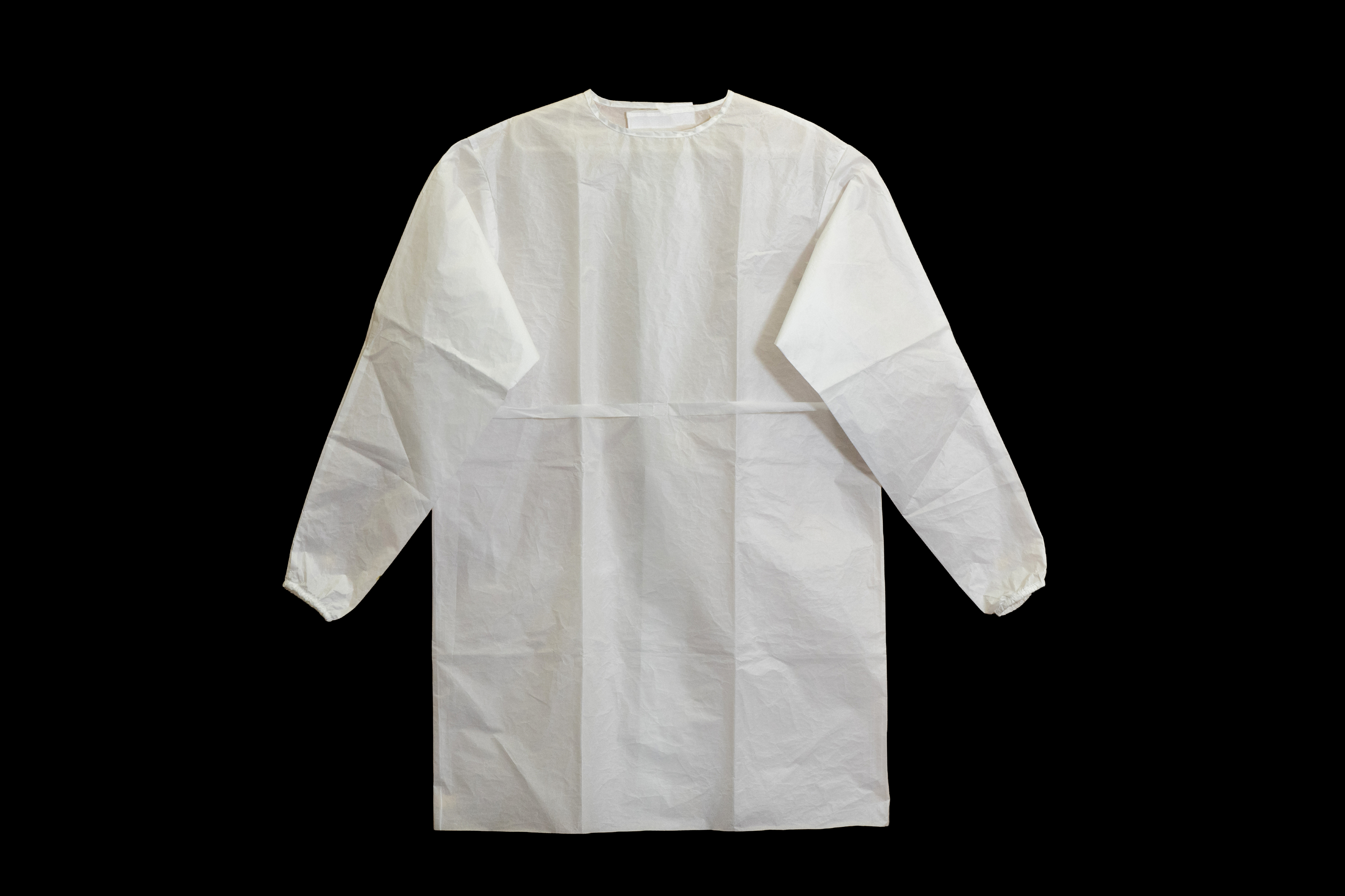
Shizuoka Prefecture emergency medical gowns
The COVID-19 Pandemic caused a shortage of gowns at medical facilities in Shizuoka Prefecture.
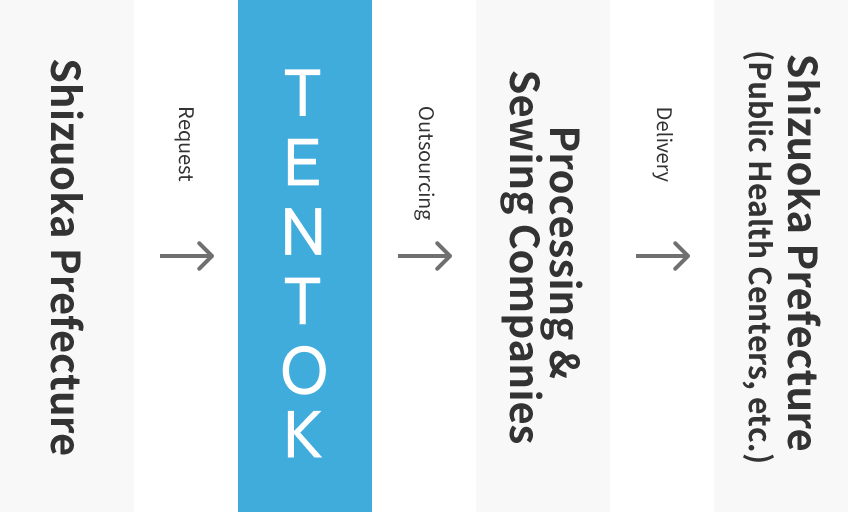
In order to establish a production system in the prefecture, TENTOK developed and provided fabrics.
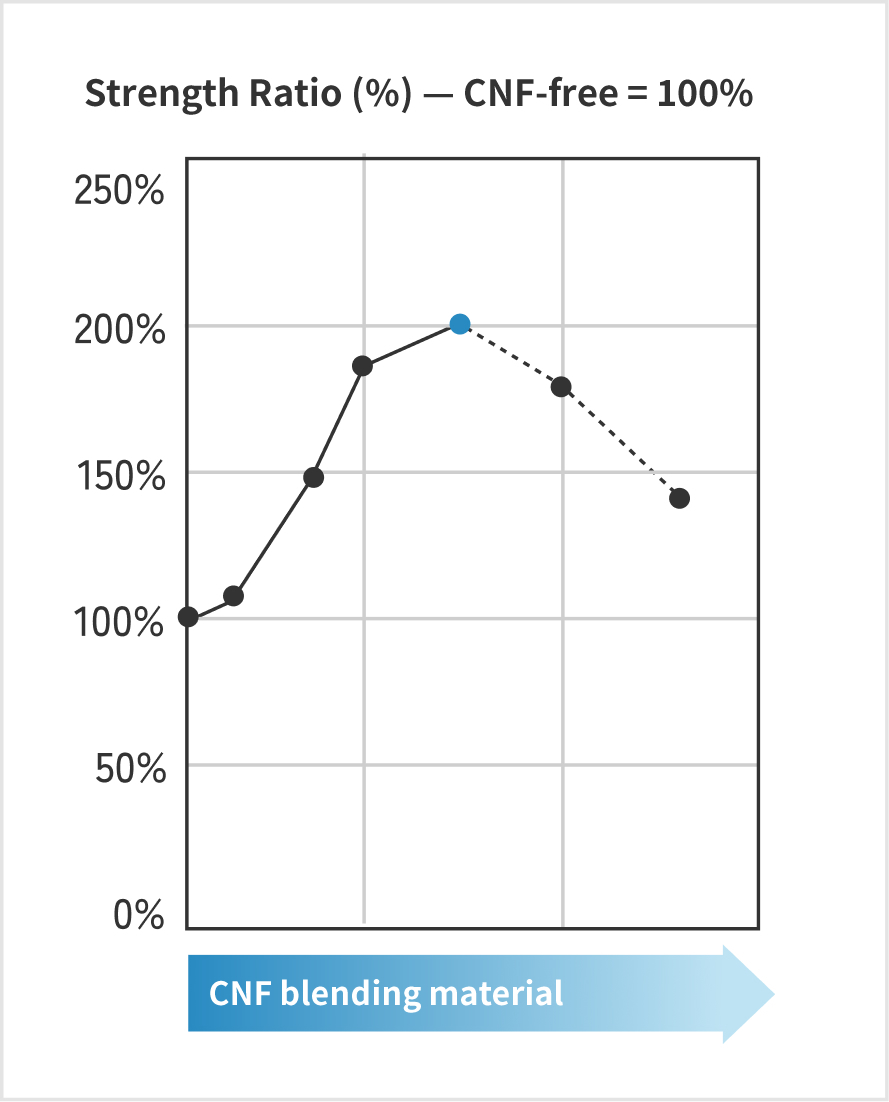
Fabrics made solely from synthetic fibers tend to have low tear strength, so there is a risk of tearing during sewing or use!
→The tearing strength is approximately doubled by blending MFC.
-
The changes in strength accompanying the CNF blending material

-
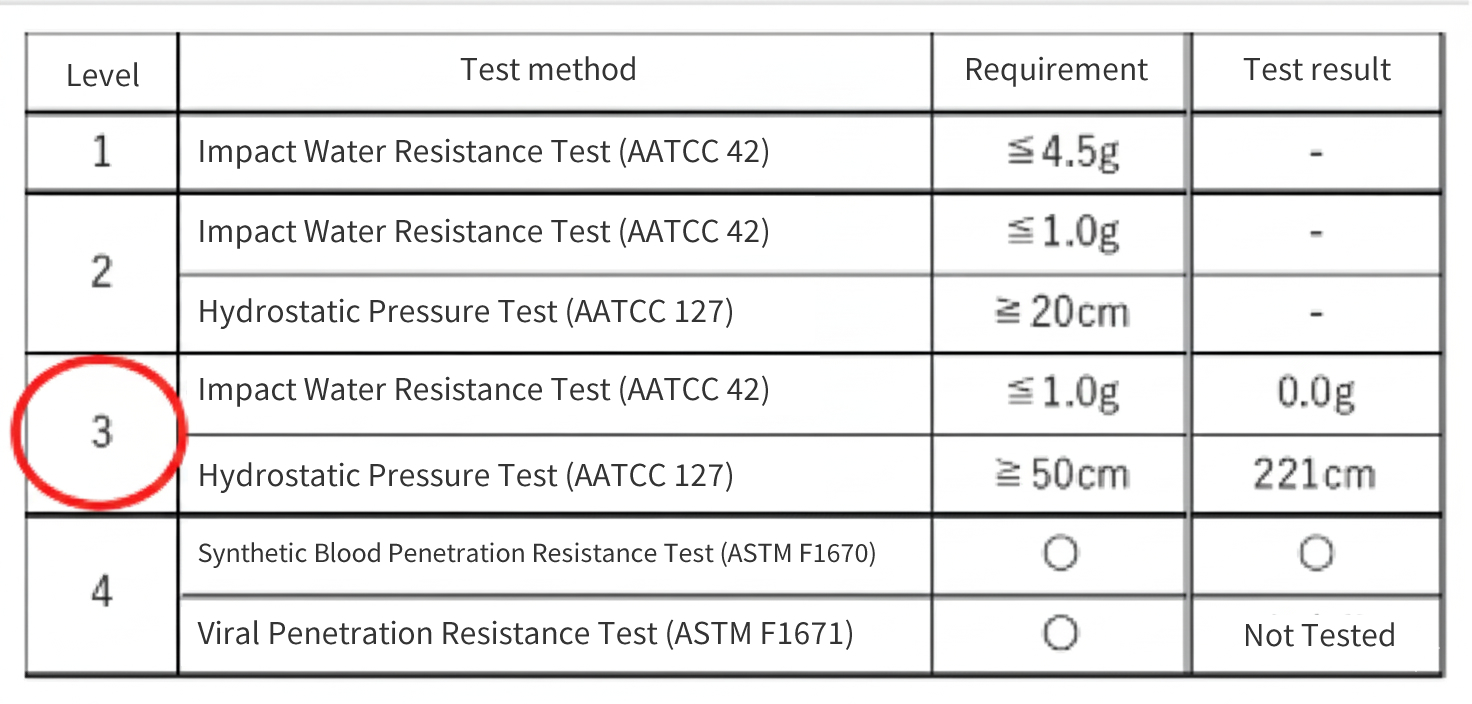
AAMI PB70 test results for substrates for use with gowns

-
Emergency medical gown production flow

-
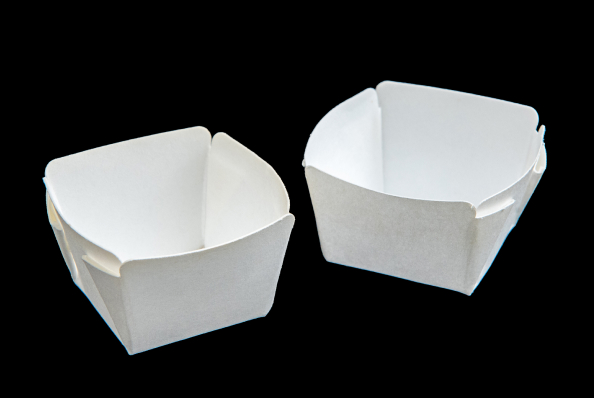
Packaging materials and structural components
-
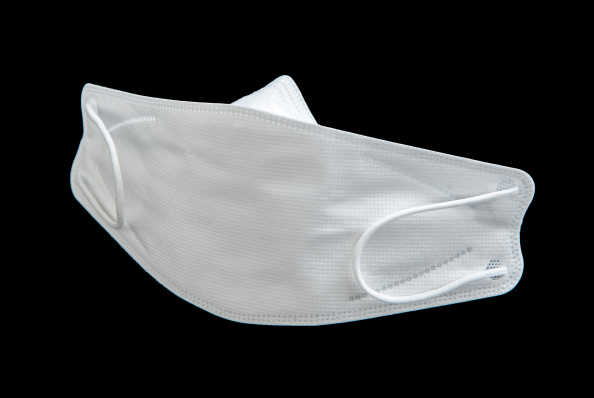
Masks
-
Car body ceiling material
HOWA Co., Ltd. / Kanazawa Institute of Technology / TENTOK Joint Development